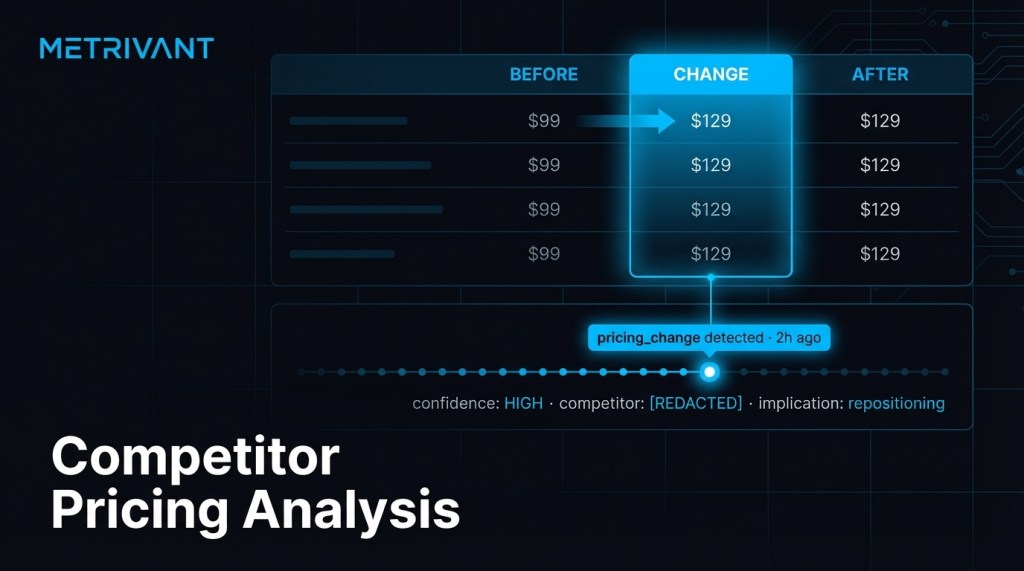
Your competitor just changed their pricing page. You have three options: match their price, differentiate your positioning, or hold your ground. The problem is that without a systematic detection process, you find out about the change three weeks after it happened — in a prospect question you were not prepared for. Competitor pricing analysis is the practice of knowing first, and knowing what to do about it.
This guide covers what competitor pricing analysis is, what pricing signals actually tell you, and how to build a response framework that gives your sales and product teams actionable context before the next deal closes.
Quick Answer: Competitor pricing analysis is the practice of continuously monitoring competitor pricing pages, tier structures, and price-adjacent signals — and classifying what each change means for your own positioning and sales conversations. The most effective approach combines automated page monitoring with a structured signal classification process, so your team responds to competitor price changes before they appear in a loss debrief.
Why Competitor Pricing Changes Are Never Just About Price
When a competitor restructures their pricing page, the instinct is to look at the numbers. Did they raise prices? Drop prices? Add a new tier? Those are useful questions, but they miss the deeper strategic signal.
Pricing page changes are almost always a downstream symptom of a strategic decision made weeks or months earlier. When Mercury restructured their pricing page in March 2026, the change in tier language — from startup-tier to growth-tier framing — was not a pricing adjustment. It was an ICP expansion. The company had decided to move upmarket, and the pricing page was one of several surfaces where that decision became visible.
The teams that caught that signal as a strategic indicator, not just a pricing update, had weeks to adjust their competitive positioning, update their battlecards, and coach their sales reps before the new Mercury pitch landed in a shared deal.
Competitor pricing analysis done well reads through the price to the strategy behind it.
What Pricing Signals Tell You (Beyond the Numbers)
Five types of pricing signals deserve attention in every CI program:
Tier restructuring: When a competitor reorganizes their plan tiers — new names, different feature groupings, new entry or exit points — they are almost always signaling a change in ICP definition or go-to-market motion. This affects how your sales team positions against them in specific segments.
Feature-to-tier remapping: A feature moved from a higher tier to a lower tier means the competitor is using that feature as a growth driver rather than a premium differentiator. A feature moved up means they are building a moat around it. Both are product strategy signals, not pricing signals.
CTA language changes: “Get started” vs “Book a demo” vs “Talk to sales” signals where the competitor is positioning their acquisition motion. A shift from self-serve CTAs to sales-led CTAs indicates an upmarket move. The reverse indicates a PLG push.
Pricing page removal or “contact us” gates: When a competitor removes published pricing entirely and replaces it with a sales-gated form, they are moving upmarket and signaling that deal size expectations have changed significantly.
Annual vs monthly framing changes: Shifting emphasis from monthly to annual pricing — or introducing significant annual discounts — indicates a focus on reducing churn and improving net revenue retention. This is a company health signal.
How to Build a Competitor Pricing Analysis Process
Step 1: Identify Which Competitor Pages to Monitor
For each competitor, monitor at minimum: the primary pricing page, the features/product page that maps features to tiers, and the homepage (where ICP and positioning claims appear). For competitors with a pricing FAQ, changelog, or enterprise page, add those as well.
Prioritize pages that are decision-facing — pages your prospects visit before evaluating your product. Changes to those pages have the most direct impact on your conversion rates.
Step 2: Establish Your Pricing Baseline
Before you can detect a change, you need a baseline. For each competitor pricing page, capture:
- Tier names and count
- Price points (monthly and annual)
- Feature-to-tier mapping for the top 10 features
- CTA copy and placement
- Any free tier or trial offer details
- The exact headline and subheadline
This baseline becomes the comparison point for every future change. Without it, you are pattern-matching from memory rather than from evidence.
Step 3: Detect Changes in Real Time
Manual monitoring — a weekly check of competitor pricing pages — misses the majority of changes. Meaningful pricing changes are made on Tuesday mornings when no one is watching, not in scheduled quarterly announcements.
Metrivant crawls competitor pricing pages every 60 minutes and compares each snapshot against the verified baseline. When a change is detected, it runs through the signal classification pipeline before surfacing. You see the change within the hour — not in next week’s manual review.
Step 4: Classify the Pricing Signal
Not all pricing page changes warrant the same response. A minor copy edit to a feature description in the small print is different from a full tier restructure. Signal classification determines which changes require immediate action and which require monitoring.
Classification framework for pricing signals:
- pricing_change — A direct price point adjustment (immediate notification to sales)
- positioning_shift — Tier names, ICP framing, or CTA language change (update battlecard)
- feature_launch — New feature added to a tier (assess product gap)
- feature_remapping — Existing feature moved between tiers (review competitive differentiation)
- copy_edit — Minor text changes with no strategic significance (log, no action required)
Step 5: Build Your Response Playbook
Each signal classification should trigger a predefined response. A classification of pricing_change triggers a sales team notification within 24 hours. A positioning_shift triggers a battlecard review within 72 hours. A feature_launch triggers a product gap assessment within one week.
Without a predefined playbook, even the best CI infrastructure produces intelligence that sits in a Slack channel and never reaches the people who need it in a deal conversation.
How to Respond to Competitor Pricing Changes: Match, Differentiate, or Hold
Detecting a competitor pricing change is the first step. The more consequential step is deciding what to do about it. Most teams default to one of three poor responses: panic-matching (immediately lowering price to stay competitive), ignoring the change, or escalating without a recommendation. A structured response framework replaces those defaults with a decision logic based on the type and strategic context of the pricing change.
Match
Match when the competitor is moving into an identical segment with a direct price reduction and your existing customers are vulnerable. Matching is appropriate when: (a) the competitor is targeting your active renewal cohort, (b) the price change is in a tier that currently determines your win rate, and (c) you have margin to absorb the change without structural harm. Matching buys retention but concedes the value narrative. Match only when the alternative is immediate customer loss — not as a reflexive competitive response.
Differentiate
Differentiate when the competitor’s pricing change reveals a strategic gap you can exploit. If a competitor moves upmarket — raising prices, removing a self-serve tier, or gating pricing behind a sales call — that opens downmarket space. If they restructure features upward into premium tiers, that creates a stronger value-per-dollar story at your current positioning. Differentiation is the most durable response because it turns their decision into your advantage. The key is speed: differentiation requires updating your sales narrative and battlecard before the competitor’s new positioning reaches your next prospect conversation.
Hold
Hold when the pricing change is a signal of competitive weakness rather than strength. A competitor cutting prices dramatically may be responding to churn pressure — not winning new customers. A competitor adding aggressive annual discounts may be trying to lock in revenue ahead of a difficult quarter. A competitor gating pricing behind a “contact us” form after years of transparent pricing may be struggling to justify their value in self-serve evaluations. Holding — maintaining your current pricing while updating your sales narrative to reframe the competitor’s change as a vulnerability signal — is often the most strategically sound response to distress signals masquerading as aggression.
The Four-Question Decision Checklist
Before responding to any competitor pricing change, answer these four questions:
- Which segment is the competitor targeting with this change? If it is a segment where you have strong retention and high NPS, the risk is lower than if it is your primary acquisition segment.
- Is this a price change or a positioning change? A number change is tactical. A tier restructure combined with new ICP language is strategic and requires a strategic response.
- Have you seen corroborating signals? A pricing change that appears alongside a homepage repositioning, a feature launch, and new hiring signals is a coordinated move requiring an urgent response. A standalone pricing edit is lower urgency. According to the 2026 State of Competitive Intelligence, coordinated multi-signal moves are significantly more likely to affect customer renewal rates than isolated pricing changes.
- What is the recommended action from your signal classification? A pricing_change signal triggers a sales team notification. A positioning_shift combined with pricing_change triggers a battlecard review and a PMM response brief within 72 hours.
What a Real Pricing Intelligence Detection Looks Like
In March 2026, Metrivant’s pipeline detected Mercury (mercury.com) making a coordinated product and positioning move across three pages within a 72-hour window. The signal was classified as feature_launch + positioning_shift, resolved to product_expansion + market_reposition.
The pricing intelligence component of the detection was specific: Mercury’s pricing page was restructured with new tier language separating startup-tier from growth-tier messaging. The before/after diff was fully inspectable:
Before: Pricing tier framed around “startups” — startup-specific language throughout.
After: Tier language separated into startup-tier and growth-tier framing — explicit ICP segmentation introduced without announcement.
A fintech PMM using Metrivant at that time had the full evidence chain — the exact diff, the classification, the confidence score, and one recommended action — available the same day. The recommended action: update the competitive battlecard for Mercury to reflect their upmarket move and prepare a counter-narrative for deals where Mercury is present.
Teams tracking Mercury manually would have discovered this in a loss debrief. The window between the pricing page change and Mercury’s first public acknowledgment of their repositioning was 21 days.
That 21-day window is what competitor pricing analysis is designed to capture.
How Metrivant Handles Competitor Pricing Analysis
Metrivant monitors competitor pricing pages every 60 minutes — the highest crawl frequency available in any CI tool at this price point. Every change detected runs through the 8-stage signal pipeline:
- Capture: Page content fetched on schedule
- Extract: Structured data extracted from raw HTML
- Baseline: Current state compared against verified baseline
- Diff: Precise before/after change identified at the text level
- Signal: Change classified (pricing_change, positioning_shift, feature_launch, etc.)
- Intelligence: Strategic implication derived from classification
- Movement: Corroborating signals across other pages identified
- Radar: Signal surfaced with confidence score and recommended action
The result is a competitor pricing change that arrives with a before/after excerpt, a classification, a confidence score, a strategic implication, and one concrete next step. Not a notification that something changed — an intelligence brief you can act on.
See the full list of best competitive intelligence tools in 2026 for a comparison of how other platforms handle pricing intelligence.
Frequently Asked Questions
What is competitor pricing analysis?
Competitor pricing analysis is the systematic monitoring of competitor pricing pages, tier structures, and price-adjacent signals — and the interpretation of what each change means for your own positioning and sales conversations. Effective pricing analysis captures not just price points but the strategic intent behind pricing changes: ICP expansions, upmarket moves, PLG pushes, and feature repositioning. It combines automated monitoring with structured signal classification and predefined response playbooks.
How does competitor pricing analysis differ from price tracking?
Price tracking captures raw price points. Competitor pricing analysis interprets what pricing changes mean strategically. A price drop is a data point. The same price drop paired with a tier restructure and new CTA language is a strategic signal — the competitor may be commoditizing their entry tier to accelerate volume growth. Pricing analysis reads through the price to the strategy, rather than just logging what the numbers are.
How do you track competitor pricing changes effectively?
The most effective approach combines automated page monitoring at high crawl frequency (Metrivant crawls pricing pages every 60 minutes) with a signal classification framework that tells you what each change means. Manual monitoring misses the majority of changes, which are made during off-peak hours without announcements. An automated tool with deterministic page diff detection surfaces changes within minutes of occurrence, with before/after evidence available immediately.
What does it mean when a competitor removes pricing from their website?
When a competitor removes published pricing and replaces it with a “contact us” or “book a demo” CTA, it almost always signals an upmarket move. The company is either raising prices significantly (and does not want the sticker shock to disqualify them in early evaluations) or shifting to a sales-led motion where deal size is large enough to justify custom pricing. This change should trigger a battlecard update with a new counter-narrative: your transparent, self-serve pricing becomes a differentiator against a competitor who now requires a sales process just to learn what they charge.
How does Metrivant handle competitor pricing analysis?
Metrivant crawls competitor pricing pages every 60 minutes and runs every detected change through a deterministic 8-stage classification pipeline. The output is a signal brief containing the exact before/after text diff, a change classification (pricing_change, positioning_shift, feature_launch, etc.), a confidence score, a strategic implication, and one recommended action. Every signal is traceable to the specific page diff that triggered it — no AI inference in the detection layer.
What should I look for when building a competitor pricing analysis process?
Build your process around four capabilities: (1) automated monitoring at high frequency so you catch changes quickly, (2) a verified baseline for each competitor’s pricing page so changes are detectable, (3) a signal classification framework that tells you what each change type means, and (4) a response playbook that maps each signal classification to a predefined team action. Without the playbook, even excellent pricing intelligence sits unused. Also read the competitive analysis template guide for a structured framework to capture and maintain this intelligence across your full competitor set.
{
“@context”: “https://schema.org”,
“@graph”: [
{
“@type”: “Article”,
“headline”: “Competitor Pricing Analysis: How to Track and Respond to Price Changes (2026)”,
“description”: “How to track competitor pricing changes in real time, what pricing signals actually mean strategically, and how to use the Match, Differentiate, or Hold framework to respond to competitor price changes before they appear in a loss debrief.”,
“url”: “https://metrivant.blog/2026/03/30/competitor-pricing-analysis-how-to-track-and-respond-to-price-changes-2026/”,
“datePublished”: “2026-03-30”,
“dateModified”: “2026-04-01”,
“author”: {“@type”: “Organization”, “name”: “Metrivant”, “url”: “https://metrivant.com”},
“publisher”: {“@type”: “Organization”, “name”: “Metrivant”, “url”: “https://metrivant.com”}
},
{
“@type”: “FAQPage”,
“mainEntity”: [
{“@type”: “Question”, “name”: “What is competitor pricing analysis?”, “acceptedAnswer”: {“@type”: “Answer”, “text”: “Competitor pricing analysis is the systematic monitoring of competitor pricing pages, tier structures, and price-adjacent signals — and the interpretation of what each change means for your own positioning and sales conversations. Effective pricing analysis captures not just price points but the strategic intent behind pricing changes: ICP expansions, upmarket moves, PLG pushes, and feature repositioning.”}},
{“@type”: “Question”, “name”: “How does competitor pricing analysis differ from price tracking?”, “acceptedAnswer”: {“@type”: “Answer”, “text”: “Price tracking captures raw price points. Competitor pricing analysis interprets what pricing changes mean strategically. A price drop is a data point. The same price drop paired with a tier restructure and new CTA language is a strategic signal — the competitor may be commoditizing their entry tier to accelerate volume growth. Pricing analysis reads through the price to the strategy.”}},
{“@type”: “Question”, “name”: “How do you track competitor pricing changes effectively?”, “acceptedAnswer”: {“@type”: “Answer”, “text”: “The most effective approach combines automated page monitoring at high crawl frequency (Metrivant crawls pricing pages every 60 minutes) with a signal classification framework that tells you what each change means. Manual monitoring misses the majority of changes. An automated tool with deterministic page diff detection surfaces changes within minutes of occurrence, with before/after evidence available immediately.”}},
{“@type”: “Question”, “name”: “What does it mean when a competitor removes pricing from their website?”, “acceptedAnswer”: {“@type”: “Answer”, “text”: “When a competitor removes published pricing and replaces it with a contact us CTA, it almost always signals an upmarket move. The company is either raising prices significantly or shifting to a sales-led motion where deal size is large enough to justify custom pricing. Your transparent self-serve pricing becomes a differentiator against a competitor who now requires a sales process just to learn what they charge.”}},
{“@type”: “Question”, “name”: “How does Metrivant handle competitor pricing analysis?”, “acceptedAnswer”: {“@type”: “Answer”, “text”: “Metrivant crawls competitor pricing pages every 60 minutes and runs every detected change through a deterministic 8-stage classification pipeline. The output is a signal brief containing the exact before/after text diff, a change classification, a confidence score, a strategic implication, and one recommended action. Every signal is traceable to the specific page diff that triggered it.”}},
{“@type”: “Question”, “name”: “What should I look for when building a competitor pricing analysis process?”, “acceptedAnswer”: {“@type”: “Answer”, “text”: “Build your process around four capabilities: (1) automated monitoring at high frequency, (2) a verified baseline for each competitor’s pricing page, (3) a signal classification framework that tells you what each change type means, and (4) a response playbook that maps each signal classification to a predefined team action. Without the playbook, even excellent pricing intelligence sits unused.”}}
]
}
]
}
 Metrivant
Leave a reply to Competitive Analysis Template (Free, Detailed 2026) – Metrivant Cancel reply